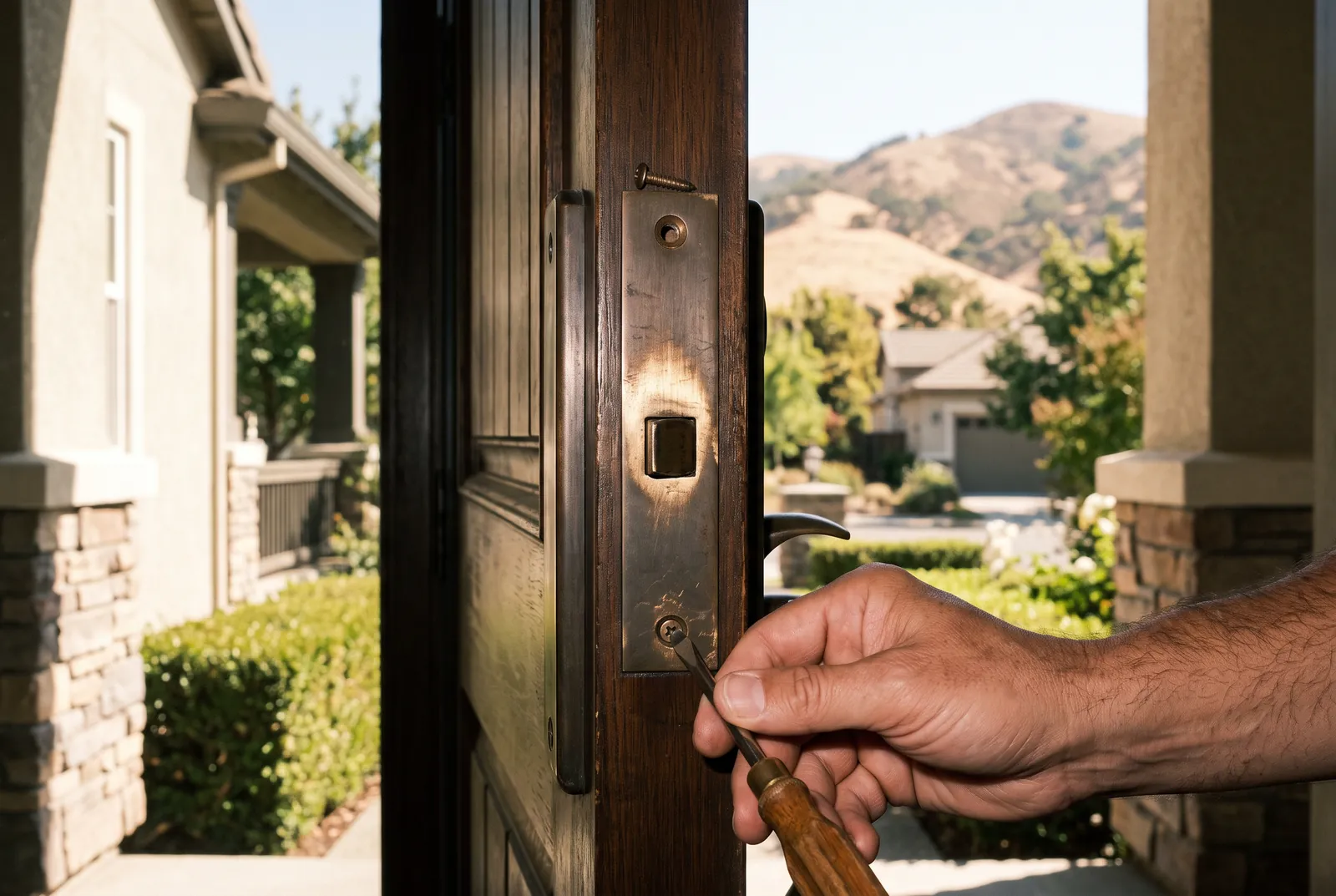
The part nobody has ever looked at
Open your front door and look at the frame rather than the leaf. There is a small plate of metal set into the jamb at the height of the latch, with an opening in it and usually a second one above for the deadbolt. That is the strike. It has been there since the house was built, it has never been painted around properly, and it is almost certainly the only part of the entry that has never once been examined by anybody.
It is also half of every lock on the door. A deadbolt is a steel bar that slides sideways. On its own it does absolutely nothing. The security of the door, and whether it can be locked at all, comes from that bar entering a hole in the frame and staying there. The lock supplies the bar. The strike supplies the hole. Spend four hundred dollars on the first and nothing on the second and you have bought a very good bar.
Which is why a great many visits in this town end at the frame rather than at the lock. A household calls about a deadbolt and the deadbolt goes back on the door untouched.
Four parts, and what each of them does
The plate itself is the visible steel. Its job is to give the latch a hard face to ride over instead of chewing into the wood of the jamb, and to spread load. The angled tab on the front edge, the lip, is what pushes the spring latch back as the door swings closed. When that lip is bent, worn flat or sitting at the wrong angle, the latch catches on it and the door bounces back open, which people describe as a door that will not stay shut.
Behind the plate is the pocket, a hole bored or chiselled into the jamb for the bolt to actually enter. This is the part that is skipped on a fast install. A pocket that is only three-eighths of an inch deep gives a one-inch deadbolt no chance of getting its full length into anything, and on a surprising number of doors the pocket has been half filled with paint over three repaints. The bolt hits the paint, stops, and the key still turns, so nobody knows.
Then the screws. On most houses these are three-quarters of an inch long and they hold the plate to the jamb, which is a thin board tacked to the framing behind it. Whatever the lock is rated for, that assembly is as strong as two short screws in a piece of trim. Replacing them with screws long enough to reach the structural framing behind the jamb costs the price of a coffee and changes the door more than any hardware purchase available.
And finally the alignment, which is not a part at all but the relationship between everything above and the bolt coming toward it. Everything else on this page can be perfect and the door will still fail if the bolt arrives half an inch below the hole.
The four failures, and how each one sounds
A door that will not stay closed and springs back at you is a lip problem. The latch is hitting the angled tab and being pushed back out rather than being guided in. Bending it back, or fitting a plate with a deeper lip, is a five-minute job.
A door that closes but rattles when the wind comes down off the hills is a gap problem. The latch is in the hole, but the hole is further into the frame than the latch wants to sit, so the leaf never gets pulled tight against the stop. An adjustable strike, or the plate reset a fraction, ends it.
A key that only turns if you lift the handle or lean on the leaf is an alignment problem, and it is by far the commonest version here. The bolt is arriving at the edge of its hole instead of the middle, and the household has been correcting for it by hand for so long that nobody remembers when it started.
And a bolt that goes out most of the way and then stops with a dull sound is a pocket problem. There is not enough room behind the plate, either because the pocket was never cut deep enough or because it has silted up with paint. The lock feels locked. The door has about half a bolt holding it.
Why this town eats strikes
The doors on these streets are large, heavy and solid, and they sit in a valley that goes from a cold wet morning in January to a dry afternoon past a hundred in a heat wave. The leaf grows, shrinks and settles, and every one of those movements shows up as the bolt arriving somewhere slightly different. The strike is the fixed reference the moving door has to hit.
So a strike here is not fitted for today. It is fitted for the range. The pocket gets cut deeper than the bolt strictly needs and, where the leaf has proved it moves a lot, wider in the direction the movement runs, so the bolt has a landing area rather than a target. The plate is then set so the bolt sits centered on the middle of the year rather than centered on the day the technician happened to be standing there. Done that way, the door locks in February and it locks in August without anybody putting a shoulder into it.
That is also the reason a strike moved by half an inch on a summer afternoon by a general handyman so often produces a call in the winter. The work was not wrong. It was aimed at one season.
When the strike is not the answer
It is worth being straight about the limits. A strike repair does nothing for a worn cylinder. If the key needs a specific angle, or lifts and drops and still turns, that lock is finished regardless of what is on the frame, and replacement is $139 to $359 for that door. Nothing about the frame changes what is happening inside a plug.
It does nothing for a jamb that has actually split, either along the grain behind the plate or where a previous strike tore out. That is repair work through to the framing rather than a plate swap, and where a door has been forced at some point in its history it is priced as post break-in lock repair, $185 to $489, with the jamb rebuilt and a long strike going into structure rather than trim.
And it does nothing about who holds a key. That is a separate question with a separate answer, at $31 to $49 per cylinder, and the two jobs simply happen in the same visit when both are needed.
What it costs, said plainly
There is no line on the price list called strike plate, and that is deliberate rather than an oversight. Correcting the frame is part of making a door work, so it is inside whatever the visit is for. When the visit is about a door that will not lock, it is priced as lock replacement and installation, $139 to $359, and a job that turns out to be longer screws, a deeper pocket and a dressed lip lands at the bottom of that band. When you are already outside the house, it is a house lockout at $145 to $265 and the frame gets corrected before the technician leaves rather than being left for a second appointment.
The $89 service call sits inside the figure instead of underneath it, $55 rides on an arrival between 8pm and midnight and $95 between midnight and 7am, and the number is settled on the call. Ninety days on the work. Arrival averages 19 minutes across Danville, from 12 downtown to 26 in Blackhawk, and slower streets get told the slower number in advance rather than after half an hour of watching for a van.
The one thing worth asking for by name, whatever else is being done: screws through the strike and through the hinges that are long enough to reach the framing. They are the cheapest items in the van and they outperform every upgrade you could buy instead.
Quick answers
How do I know if my strike screws are too short?+
Take one out and look at it. Three-quarters of an inch means it is holding in the jamb board alone, which is thin trim in front of the framing. Screws long enough to reach the structure behind it are a few minutes of work and they are included in a visit rather than sold separately.
My deadbolt locks but the door still rattles. Is that dangerous?+
It is telling you the bolt is not seated the way it should be, usually because the pocket behind the plate is shallow or the plate sits too deep in the frame. Both are corrected at the frame. A bolt that only enters halfway is doing roughly half the job the lock is rated for.
Can I just move the strike plate myself?+
You can, and in this valley the risk is that you aim it at the season you are standing in. A plate moved to suit an August door often rattles by January. The pocket needs cutting so the bolt lands at both ends of the year, and the leaf usually needs bringing back on its hinges first.
Need it handled rather than read about?
(925) 431-6470