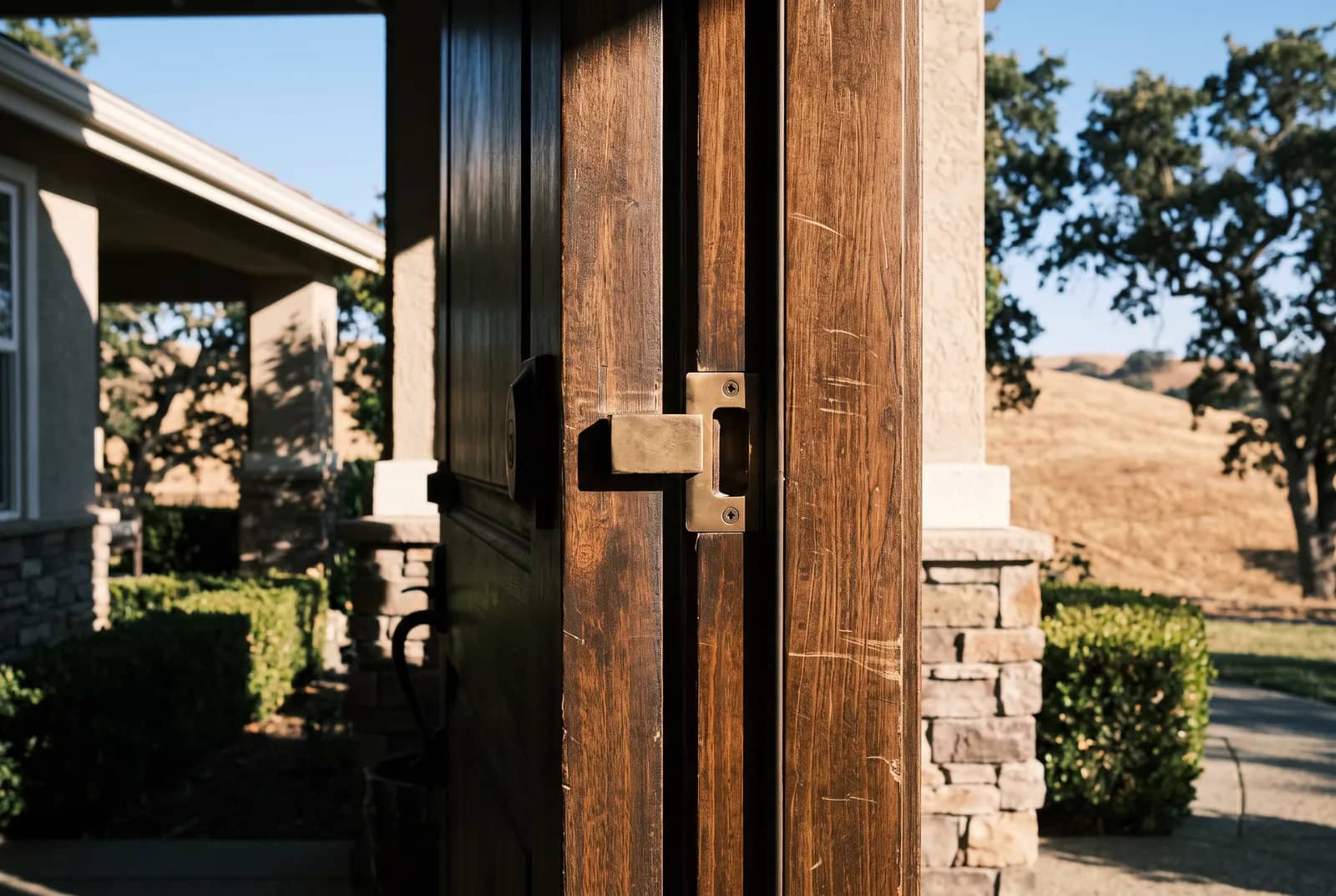
The same call, in the same week, every year
The first long stretch of heat in the valley produces a run of calls that all sound alike. The key turns and the bolt does not seat. Or the bolt starts out and stops halfway, so the key finishes its rotation against nothing. Or the whole thing works, but only if somebody puts a shoulder into the leaf first and holds it there while the key goes around. Almost everyone describing this says the lock has broken.
In nearly every one of those visits the lock is the one component that is still doing its job perfectly. It throws a bolt when a key or a turn tells it to, and it will do that on the workbench all afternoon. What has stopped working is the relationship between the bolt and the hole it is supposed to land in, and that relationship is not part of the lock at all.
The evidence is in the calendar rather than in the hardware. The identical door locked without comment through February and March. Nobody adjusted anything, nobody dropped it, nobody put a screwdriver near it. Something that changes on its own between spring and midsummer, and often changes back by Thanksgiving, is a seasonal fault, and seasonal faults live in the wood.
What actually moves
Wood takes up moisture and gives it back, and it swells and shrinks across the grain far more than along it. A door leaf therefore grows mostly in width, which is exactly the direction that matters, because width is what closes the gap on the latch side. The frame is doing the same thing at the same time, but the frame is nailed to the framing of the house and the leaf is hanging on three hinges, so the two do not arrive at the same place by the same route.
Danville sits in the San Ramon Valley, on the inland side of the ridge, and does not get the marine air that keeps the shoreline towns even. Summer afternoons here are hot and dry, and in a heat wave they run past a hundred. A winter morning and a July afternoon are separated by several dozen degrees, and the humidity swings with them. A front door on a west or south elevation takes the full weight of that on one face while the inside face sits in a conditioned room, which is the arrangement wood likes least.
How far does it go. Nobody stands there with a gauge, and any number quoted as measured should be treated with suspicion. What a technician who has done a few hundred of these expects, across a wide solid leaf between a wet winter and a dry August, is something on the order of a quarter of an inch of accumulated change at the latch edge, taking the hinge side into account as well. That sounds like nothing. A strike hole is cut close around the bolt, and there is very little spare room in it, so a quarter of an inch is not a small amount at all. It is the whole tolerance and then some.
Why the doors here move more than most
The bulk of Danville was built between the seventies and the turn of the century, and the front doors of that period are wide, thick and solid, frequently with a glass sidelight beside them and sometimes with one on either side. There is simply more material in a leaf like that than in a narrow flush door, and every square foot of it responds to the season. The bigger the panel, the more visible the result at the edge.
A leaf of that weight also works on its hinges. Three hinges, three or four screws each, all of them holding a considerable mass through twenty or thirty summers of it opening and closing. Short screws lose their grip in the jamb before anything else does, the top hinge takes most of the load, and the leaf settles a fraction toward the latch side. That part is not seasonal. It does not come back in January.
The two effects stack, and the stacking is what people notice as the problem getting worse. A door that only misbehaved in August starts misbehaving in June, then in May, and then a household finds itself lifting the handle all year to make the key go around. By that point there are two separate faults to correct and only one of them has anything to do with the weather.
Three checks before you call anybody
First, take the frame out of the equation. Swing the leaf well clear so it is hanging in open air, then run the bolt all the way out and back with the inside turn. If it travels the full distance easily with nothing to hit, and fights you the moment the door is shut, the lock is not the fault and no lock you buy will fix it. That takes about eight seconds and it settles the biggest question on this page.
Second, look at the strike, the metal plate on the frame. Where a bolt has been arriving at the wrong height there will be a bright scar on the plate above or below the hole, the paint worn back to steel by hundreds of attempts. The position of the scar tells you which way the leaf has gone. A scar on the lower edge means the door has dropped, which points at the hinges. A scar on the face beside the hole means the leaf is standing proud of where it used to sit, which is the seasonal half.
Third, shut the door and run a business card down the gap between the leaf and the frame on the latch side, from the top corner to the bottom. Note where it goes through freely and where it stops dead. A gap that is generous at the top and pinched at the bottom, or the other way around, tells you the leaf is no longer parallel to the frame, which is again the hinges rather than the weather. Do this once in February and once in August and you will know your own door better than anyone who arrives to look at it.
The repair has to survive both ends of the year
This is where a lot of cheap fixes go wrong. If somebody simply moves the strike plate to wherever the bolt happens to be in July, the door will lock beautifully for two months and then rattle in its frame all winter, with the bolt swimming in a hole cut in the wrong place. The correct sequence deals with the permanent part first and the seasonal part second.
The permanent part is the leaf, so that comes first: the hinge screws come out and go back in long enough to bite structure rather than trim, the top hinge is shimmed where it needs to be, and the leaf is brought back toward the line it was hung on. On a door that has been sagging for years this alone puts the bolt most of the way back where it belongs, and the household usually notices it in the sound the door makes before they notice it in the key.
The seasonal part is handled at the strike. The pocket behind the plate is cut deeper and, where the movement warrants it, given enough room that a bolt arriving from either end of the year still has somewhere to go, with the plate positioned so the bolt is centered on the average rather than on today. The lip that the latch rides over is dressed so the latch stops catching on the way in. Where a compression weatherstrip has gone hard and is adding its own resistance, it is replaced, which costs very little and takes a surprising amount of effort out of closing the door.
Planing the edge of the leaf is the last resort and it is treated as one, because it cannot be undone in November when the wood shrinks again. Where it genuinely has to happen it is kept to the minimum and the bare edge is sealed the same day, since raw wood on a door in this climate drinks moisture and comes back worse than it started.
What it costs, and when it really is the lock
Work of this kind is priced as lock replacement and installation, $139 to $359, and it sits at the lower end of that band when nothing is being bought and the visit is hinge screws, a strike re-cut and a weatherstrip. The $89 service call is contained in whatever figure you are given rather than appearing under it, arrival between 8pm and midnight carries $55 and between midnight and 7am carries $95, and all of that is settled while you are still on the phone. Ninety days on the work, and on this job the ninety days covers the door as much as the lock, since the door is most of what was touched.
The average across town is 19 minutes, running from about 12 in Downtown Danville to 26 out in Blackhawk, and the number you are told is the one for your street rather than the average.
There are cases where the lock genuinely is the problem, and they identify themselves. A key that has to be jiggled and coaxed in every season, not just in August. A bolt that drags and grinds with the door standing wide open. A cylinder so worn that the key can be lifted or dropped a fraction and still turn. Those are hardware, and a rekey at $31 to $49 a cylinder will not rescue them, because new pins in a worn plug give you a tired lock with a fresh key. If that is what is on your door you will be told it with the cylinder in hand rather than guessed at from the driveway.
And if the door has already won and you are standing outside it, that is a house lockout at $145 to $265, opened without damage wherever the mechanism allows. It is worth saying on that call that the door has been sticking since June, because then the technician arrives expecting to correct the leaf as well as open it, and the second visit does not have to happen.
Quick answers
The key turns but the door will not lock unless I push it. Is the lock failing?+
Almost certainly not. Swing the leaf clear of the frame and send the bolt out with the inside turn. Full travel in open air and a fight once the door is shut means the bolt is arriving off-center at the strike, which is hinges and frame work rather than hardware. It is priced inside the $139 to $359 band and usually near the bottom of it.
It fixed itself in October. Will it come back next summer?+
The seasonal half comes back every year, and the permanent half gets slightly worse each time. If the leaf is brought back onto its hinge line and the strike pocket is cut to accept the bolt at both ends of the year, it stops being an annual event. A strike simply moved to suit July will rattle in January.
Should I plane the edge of the door myself?+
It is the last thing to do rather than the first, because in November the wood shrinks and you cannot put it back. Longer hinge screws into framing, a deeper strike pocket and a fresh weatherstrip solve most of these without removing any wood. Where planing is genuinely needed it is kept small and the bare edge is sealed the same day.
Need it handled rather than read about?
(925) 431-6470