Three things that get called the same thing
A fair share of Danville lives behind a gate of some kind. Blackhawk sits on the east side with a staffed entrance and shared driveways behind it. Crow Canyon Country Club is gated around its golf course. Several smaller pockets around town share an entrance, a pedestrian gate or a mail kiosk between a handful of houses. All of those arrangements produce calls, and the calls arrive sounding identical: the gate will not let me in, or I need another one of these.
Underneath that there are three separate categories of hardware, and almost every difficulty in this article comes from treating them as one. First, credentials for the vehicle gate: fobs, cards, clickers and codes, which are entries in a system somebody else administers. Second, mechanical locks on common property: the pedestrian gate, the pool gate, the mail kiosk, an equipment room. Third, everything on your own lot, which is your front door, your side gate, your garage service door and your shed.
The third category is straightforward and it is most of what a locksmith does here. The first two are where people lose an afternoon.
The vehicle gate fob is not a locksmith item
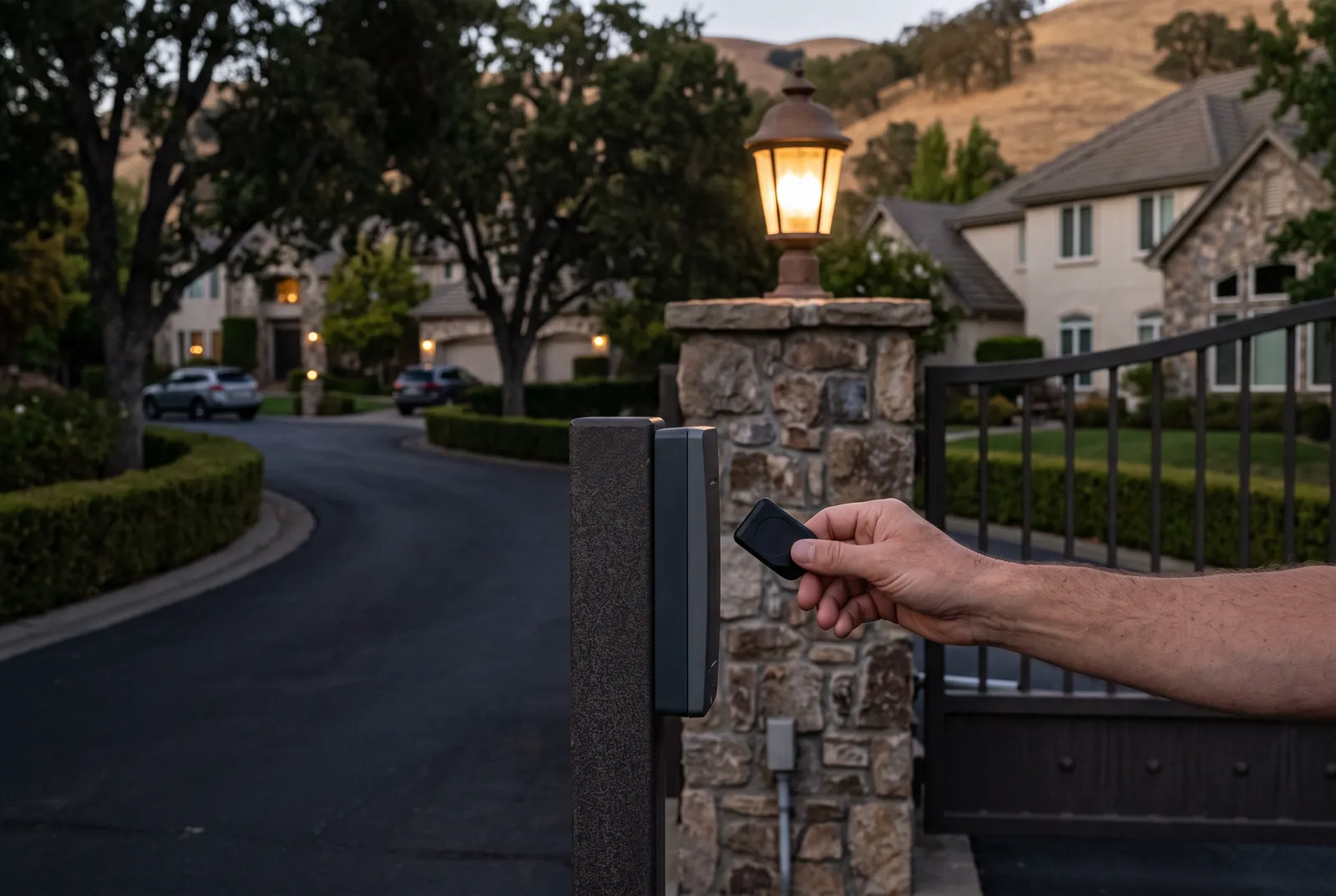
A fob for a community entrance is not a key. It is a number, held on a list inside the system that runs the gate, tied to an address and usually to a name. Making the gate open for a new fob means adding that number to the list. Nothing about that operation involves cutting, pinning or picking anything, and nobody outside the association can do it, which is exactly the arrangement residents should want.
So when a fob stops working there are two realistic explanations, and neither is a locksmith call. Either the fob itself has died, in which case the management office issues a replacement and puts the new number on the list, or the number has been removed from the list, which happens after a sale, after a change of management company, or after the system was cleaned up and a household that had four credentials was reset to two. The office can tell you which in about a minute.
This gets confused with car work, which genuinely is ours. A remote or proximity fob for a vehicle is key fob programming at $99 to $215, and a lost car key cut and coded at the curb is $169 to $455. Those are done where the car stands. A community gate credential is a different object that happens to live on the same ring, and pretending otherwise would waste a trip you paid for.
The pedestrian gate, the pool gate and the mail kiosk
These are mechanical, they wear out, and they are the second category. A cylinder on a pool gate in this valley spends its whole life outdoors in full sun. A pedestrian gate latch is opened and shut all day and fights a self-closing spring that has been pulling on it since the day it went up. A mail kiosk lock is a small cylinder in an aluminum door that moves in the heat like everything else here. All of it is ordinary locksmith work, and none of it is yours to order.
Common property is ordered by whoever is responsible for it, which is the board or the management company, not the household nearest to it. That is not a formality invented to be difficult. A cylinder on a shared gate serves every resident who uses that gate, and a rekey changes what all of them are carrying. One resident cannot decide that on behalf of the rest, and a locksmith who takes that instruction is creating a problem for the association and for the resident who paid.
So the honest answer to somebody standing at a broken common gate is a short one. Report it to the office, get the work authorized, and it can be on the schedule the same day if somebody at the office picks up. Where the gate has failed in a way that leaves people unable to get out, that is a different urgency and gets treated as one, with the office notified rather than bypassed.
Who signs, and who gets the invoice
The paperwork question is worth two minutes before the work rather than a month afterward. On common property the instruction should come in writing from a named person with authority for it: a manager, a board member with the maintenance portfolio, whoever the association has designated. An email naming the gate, the work and the person authorizing it is enough. That email is what makes the invoice payable by the association rather than by the individual who happened to make the call.
Where a resident asks for common work at their own expense, and that does occasionally make sense, it should be said out loud and confirmed with the office anyway. The failure mode is predictable: a resident pays for a cylinder on a shared gate, submits it for reimbursement, and finds the association will not pay for work it did not authorize. Nobody in that chain behaved badly. The order simply went in the wrong direction.
On your own lot none of this applies. Your front door, your side gate into your own yard, the service door on your garage and anything on your own driveway are yours to instruct and yours to pay for, and the invoice has your name on it. Rekeying is $31 to $49 per cylinder, a lock replaced and fitted is $139 to $359, and a keypad is $215 to $529. Master key systems and access control, which is what a larger association usually needs when it starts asking about the common doors properly, are quoted after the doors have been walked and counted rather than over the phone, because a gate nobody has looked at cannot be priced honestly.
Getting a van through the gate
Whatever the job, the entrance is part of the arrival time and it should be planned rather than discovered. The drive from the old center of town is about 23 minutes to Crow Canyon Country Club and about 26 to Blackhawk, and the check-in at a staffed entrance sits on top of that, not inside it. That is said on the call rather than left to surprise both of us.
Two things make it painless. Put the company name and the technician's name on the entry list before the van sets off, and be reachable on the phone number the gate has for you, because if nobody answers there the van does not come in. A text goes out before departure with the technician's name and an arrival window, which is precisely the information a gate or a guard wants to hear.
For anything that is not an emergency, book it in daylight. A gated street at ten at night is a poor place for a work van and there is no reason a sticking deadbolt cannot wait until nine the next morning. Calls are answered around the clock and a genuine lockout is treated as one at any hour, at $145 to $265 with $55 riding on an 8pm to midnight arrival and $95 after midnight, both counted into the figure before you agree to it.
What the household should keep a record of
Two short lists, and they take five minutes to write. The first is credentials: how many gate fobs, clickers or cards exist for your address, where each one physically is, and which car each one lives in. When a car is sold with a clicker in the visor, that credential is still on the association's list and only the office can remove it. A household that cannot say how many it has cannot ask for that.
The second is cylinders: every lock on your own lot that takes a metal key, including the side gate, the shed and the garage service door. That list is what a rekey is priced from, and it is the list that answers the only question that matters after a sale or a departure, which is who is holding something that still works.
Keep them where the next owner will find them. The commonest version of this call, by a wide margin, is somebody who moved in three months ago holding two fobs they cannot verify, a ring of keys nobody labelled, and no idea which office to ring about the gate.
Quick answers
Can you make me another fob for the community gate?+
No, and neither can anyone else outside the association. A gate fob is a number on a list held by the management company, and adding it is their operation rather than a cutting or pinning job. Car remotes are different and are our work, at $99 to $215 for programming.
The lock on our shared pedestrian gate is broken. Can I just book the repair?+
Report it to the office and have them authorize it, because that gate serves every household using it and changing its cylinder changes what all of them carry. With a written instruction from a manager or a board member it can usually be done the same day, and the invoice goes to the association rather than to you.
How long does it take to reach a gated street in Danville?+
About 23 minutes to Crow Canyon Country Club and about 26 to Blackhawk, plus check-in at the entrance, which is separate from the drive. Put the company and technician name on the list beforehand and stay reachable on the number the gate holds for your address.
Need it handled rather than read about?
(925) 431-6470