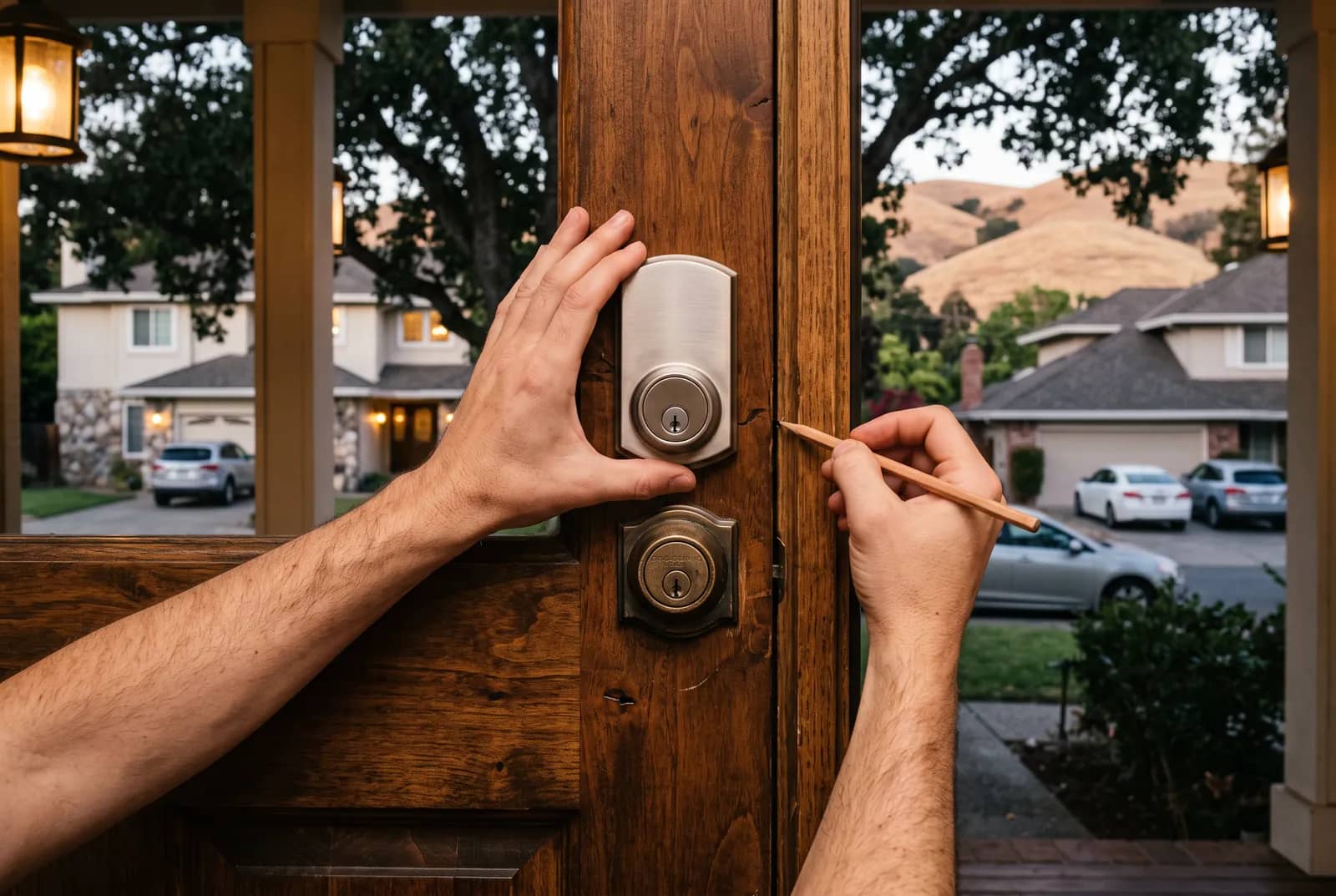
The good news about a door from 1988
By the time these streets were built, the hardware standard had settled. A door from the late eighties has a bore of two and an eighth inches through the face and a backset of two and three-eighths or two and three-quarters, which is what the lock in the box is machined for. The thickness is almost always an inch and three-quarters. None of the drilling arguments that plague a house from the fifties apply here.
That is exactly why the install goes wrong more often than people expect. The lock does go into the hole, so nobody stops to think, and the trouble only appears two weeks later as a lock that reports a jam, or two months later as a set of batteries that lasted a fifth of what the box promised.
The hole was never the problem on a door of this age. The problem is that the leaf has spent nearly forty summers in this valley, and the bolt no longer meets the middle of anything.
A motor has one strength and no shoulder
This is the whole argument, so it is worth stating plainly. A person throwing a deadbolt has an enormous range of force available and applies it without thinking. If the bolt catches, a hand pushes harder. If that does not do it, the other hand pulls the door toward the frame, or a hip goes into the leaf, and the bolt goes home. Households do this for years without ever once describing it to anybody, and if you ask them how they lock the front door they will demonstrate a small routine they do not know they have.
A motorized deadbolt has none of that. It has a gearmotor chosen to move a bolt that runs freely, a current limit, and a rule about what to do when the limit is hit, which is to stop, retry and complain. It cannot pull the door toward itself. It cannot lift the handle. Put it on a door that needs a routine and it fails at the routine, every time, and it fails hardest in the part of the year when the leaf has grown.
So the sequence that produces a working keypad in a house of this age is the opposite of the one on the packaging. The leaf is brought back onto its hinge line, the strike pocket is cut so the bolt has somewhere to land in July as well as in March, and the latch lip is dressed. Then, and only then, the electronics go on a door that a small motor can actually operate.
What still gets measured, even though the hole is right
Four things, and they take a couple of minutes between them. The stile, meaning the width of solid wood beside the bore. Entry doors of this period frequently have a glass sidelight next to them or panels within the leaf, and a wide interior housing needs a flat area to sit on. A keypad that overhangs a moulding does not seal against weather and does not sit square.
The spacing between the deadbolt and the handleset below it, measured center to center. Late-eighties entry sets are often a matched handleset and deadbolt with a fixed distance between them, and a replacement chosen from a photograph can leave you with a keypad whose housing fouls the old handle or with two mismatched sets of holes in the face of the door. This is the measurement that most often decides which lock is bought.
The condition of the existing bolt hole through the edge, which after four decades of a heavy leaf can be ovalled rather than round, and the depth of the strike pocket, which is nearly always the thing found short.
None of that changes the price of the lock. It changes which lock is worth buying, and that conversation is much cheaper before the box is opened than after.
Heat, batteries and where the keypad faces
A keypad on a Danville front door lives outdoors in a valley where the afternoons run hot and dry and go past a hundred in a heat wave. Alkaline cells lose output when they are baked through an afternoon and cooled overnight, over and over, through a summer. The same lock on a door under a deep porch and on an unshaded west-facing entry will not want its batteries at the same interval, and neither of those intervals will be the number printed on the carton.
That said, heat is the second-largest drain and it is not the one that surprises people. The largest by a distance is a bolt grinding its way past a misaligned strike on every cycle, which asks the motor for many times the current it was sized to deliver. When a household reports that a keypad eats a pack every few weeks, the answer is almost never a better battery. It is the door, and it is the same door problem this whole site is about.
Two practical habits. Change all four cells together, out of one fresh pack, on a date in your own calendar rather than whenever the lock starts complaining, and never top up a set with a survivor from last year. And decide what happens on the evening the lock is dead, which brings us to the part of the job that gets skipped everywhere.
The metal key, cut on the day
Nearly every keypad deadbolt hides an override cylinder somewhere on the housing, behind a small cap or up underneath it, and nearly every one ships with a blank that never goes anywhere near a cutting machine. It sits in the plastic bag it came in, in a drawer, inside the house it was supposed to open.
So the key gets cut at the van on the day the lock goes on, tried in the cylinder while you are standing there, and then tried again with the leaf closed against the frame. Turning easily with the door hanging open proves nothing, because the door is exactly what a key has trouble with here. Then you decide where it lives, which should not be on the ring you are holding when the door swings shut behind you.
While the cylinder is off the door it costs very little to pin it to the same key as the rest of the house, at $31 to $49. An override key you already carry for the side door is worth more than a stranger of a key hanging on a nail in the garage.
A handful of models have no override at all. If that is what is on the door, the plan gets made now rather than at eleven at night: a second exterior door that opens with an ordinary key and a key kept off the property, or a lock box screwed to something solid and out of sight. Any of those is a fine answer. None of them is an answer if it is decided after the fact, and after the fact is a house lockout at $145 to $265.
Why $215 to $529 is a range and not a price
What decides where you land inside it is the condition of the leaf, and hardly at all the badge on the box. A door still hanging where it was hung, with a strike pocket cut properly back in 1988 and an existing deadbolt coming straight out of the hole, is a short visit at the bottom of the band. A leaf that has settled, a pocket that has to be deepened and shifted, hinge screws that have to be got into structure, a lip that has to be dressed: every one of those is time, and stacked together they walk the figure toward the top.
The $89 service call rides inside that number instead of arriving under it. An 8pm to midnight arrival carries $55 and a midnight to 7am one carries $95, both settled while you are still on the phone. Ninety days on the work, and here that warranty is mostly warranty on carpentry, since the carpentry is most of what was done.
If a keypad is not really what you want, say so. A plain deadbolt fitted onto the same corrected door is $139 to $359 and does everything a household actually needs, with nothing to charge and nothing to update. The door work underneath is identical, and the door work is the part that decides whether the bolt still lands three summers from now.
Quick answers
My door is from the late eighties. Will a keypad deadbolt fit?+
Mechanically, almost certainly, because by then the bore and backset had standardized. What gets checked is the width of solid wood beside the bore, the center-to-center spacing to the handleset below, and whether the leaf still hangs where it was hung. The fit is rarely the issue on a door of that age. The alignment usually is.
The keypad works in the morning and reports a jam in the afternoon. Why?+
The leaf has grown with the heat and the bolt is dragging on the strike, so the motor hits its current limit and gives up. Bringing the door back on its hinges and cutting the strike pocket so the bolt lands at both ends of the year fixes it. A different lock will do the same thing in the same week next year.
Do I get a metal key for it?+
Yes, cut at the van the same day and tested in the door rather than on the bench, and it can be pinned to your house key for $31 to $49 while the cylinder is off. Where a model has no override cylinder at all you will hear that before it goes on the door, and a plan for a flat battery gets agreed then.
Need it handled rather than read about?
(925) 431-6470