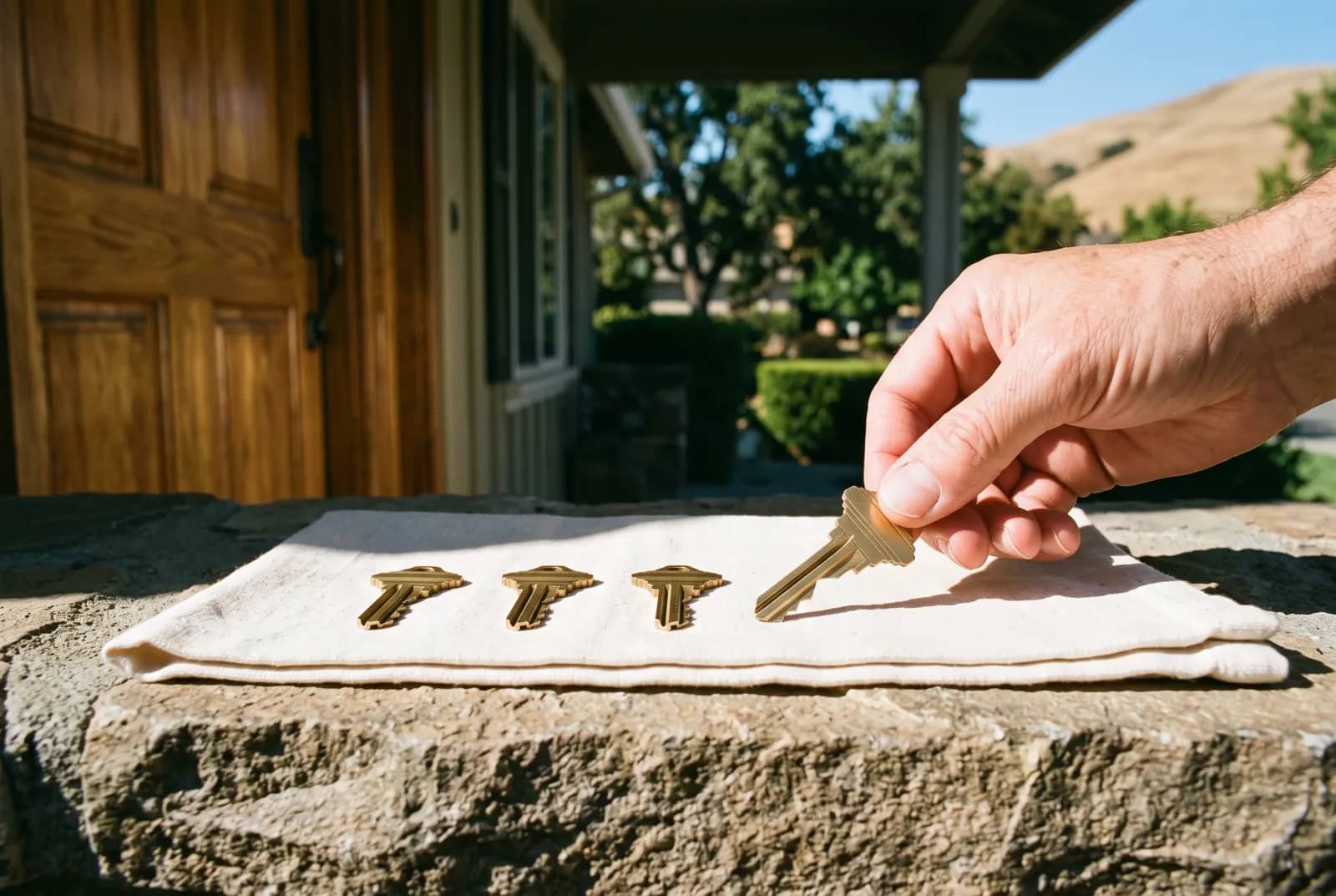
Two piles, and only one of them is ours
Empty whatever the sellers handed over onto the kitchen counter and sort it into two piles before doing anything else. The first pile is metal: house keys, a padlock key for a gate or a shed, a small flat key for a mail box or a wall safe. Every one of those is a mechanical cylinder, and every one of them can be made to forget every copy ever cut, in one visit, for a known figure.
The second pile has batteries in it: the fob or clicker for a community entrance, the garage remotes, a keypad code written on a sticky note, sometimes a card for a pool or a clubhouse. None of those has pins in it. They are entries on lists, and the lists live in three different places, none of which is a locksmith's van.
Almost every frustrating first month comes from treating the second pile like the first. Somebody books a rekey expecting the gate fob problem to be included, and it never was.
Week one: count cylinders rather than doors
Walk the property with a notepad and count keyholes, not doorways. A front entry with a handleset and a deadbolt above it is one door and two cylinders. Then the service door on the side of the garage, the gate into the back yard, a shed at the end of a long driveway in Sycamore Valley, a pool gate on your own lot, a wall-mounted mail box, and the door from the garage into the house if it is keyed at all.
Write the brand stamped around each keyhole while you are there. It is printed on almost every lock, right by the keyway, and it decides whether all of them can accept one key or whether one cylinder has to be swapped so it can join the rest. Reading five names down the phone turns a rough estimate into a figure.
Then one visit. Rekeying is $31 to $49 per cylinder. The first one carries the setup, since a combination has to be chosen and a key cut and tested to it, and everything after that is repeated to a pattern that already exists, so it lands low in the band. One $89 service call covers the stop no matter how long the list is. When it is finished, every key handed to an agent, an inspector, a stager, a painter or a gardener during the sale is scrap. That is the cheapest useful thing available in the first month, and it is also the most useful.
Nobody is being accused of anything by doing this. It is arithmetic. Over the years a house has been open to a long list of perfectly decent people, and no one was ever counting.
Week one: the lists that are not yours
The garage opener is the one people skip and it is the one that matters most, because it opens the largest door on the property straight off the street. Almost every unit of the last thirty years carries a small learn or program button on the motor housing. Held down long enough it empties the receiver, wiping every handset and every mirror button ever taught to it, including whatever went away clipped to the visor of a car the sellers no longer own. Your own two get taught back afterward. It costs nothing, it takes a few minutes on a ladder, and no rekey on earth touches it.
If the house sits behind a community entrance, ring the management office in the first week and ask two questions: how many credentials are registered to this address, and are they the ones physically in my hand. Fobs and clickers are numbers on the association's controller, so only the office can cancel one and only the office can issue another. A household that cannot say how many exist cannot ask for the extras to be removed.
And change every code in the house while you are at it. The keypad on a front door, the pad on the garage jamb, an interior alarm panel if you have the manual. Codes cost nothing to change and none of them has ever been yours until you do.
Week two: look at the doors in the season you are standing in
Before buying any hardware, spend twenty minutes on the doors themselves. Swing each exterior leaf clear of the frame and run the bolt out with the inside turn, then close the door and do it again. A bolt that travels freely in the air and has to be forced with the door shut is arriving off-center at the strike, and on a house of the age most of Danville is, that is the ordinary finding rather than a surprise.
Then take one screw out of a strike plate and look at its length, and do the same at a hinge. Short screws are holding to the jamb board and nothing behind it. Replacing them with screws that reach the framing is part of a visit rather than a purchase, and it is the single change with the best ratio of result to cost on any door in this town.
Write down which month you did this in. If you moved in during February the doors will be at their tightest by August, and if you moved in during a heat wave they will be looser in January. A house here has two door seasons, and knowing which one you have measured is the difference between a repair that lasts and one that gets undone by the weather.
The third and fourth week: what to buy, and in which order
First, a real deadbolt anywhere an exterior door is running on a latch alone, at $139 to $359 fitted, keyed into the same set so you are still carrying one key at the end of it.
Second, a spare key that has been tried in the actual door and kept somewhere that is not a hiding place. A neighbor you would trust, or a lock box screwed to something solid and out of sight. The mat, the ledge above the casing and the hollow rock by the step have been the first three places anybody checks for about fifty years.
Third, and only after week two, a keypad if you want one, at $215 to $529. Put it on the door the family walks through every day rather than the ceremonial one, and put it on a leaf that has already been corrected, since a gearmotor has no way of leaning on a door that has settled.
And one thing that turns up in a sale now and then: a safe left in a closet or a dressing room with the combination gone wherever the sellers went. That is safe opening at $219 to $589 depending on what it is, opened by feel where it stands where the mechanism allows, then set to a number you choose. A photograph of the front of it on the call gets the figure much closer.
How the money works, and the one timing trick
One figure covers the visit, the labor and the parts, with the $89 service call inside it rather than added afterward. An arrival between 8pm and midnight carries $55 and between midnight and 7am carries $95, both counted in on the call. Ninety days on the work, printed on the receipt. Arrival averages 19 minutes across Danville, about 12 downtown, 16 in Greenbrook, 19 in Sycamore Valley, 21 up at Magee Ranch and 26 out in Blackhawk, with a gated entrance adding its own check-in on top of the drive.
The trick is the timing. Book the lock work for closing week instead of moving week. Every credential worth worrying about was already in circulation while the place stood empty, and an empty house is the fastest job a technician ever gets: no furniture against the doors, no boxes in the hallway, nobody working around a family, and the entire list finished on a single stop.
Quick answers
Do I need new locks after buying, or will a rekey do?+
Rekeying covers it in almost every case. Fresh pins in the cylinder you already own kill off every copy that circulated during the sale, at $31 to $49 each, which beats paying $139 to $359 a door for hardware that was not the problem. Replacement is for a lock that has genuinely worn out, not for a lock that has changed hands.
The house is behind a community gate. Can you sort the fobs out at the same visit?+
No, and nobody outside the association can. Gate credentials are numbers on a controller the management company administers, so cancelling old ones and issuing new ones is a call to the office. What can be done in the same visit is every metal cylinder on your own lot, plus wiping the garage opener memory.
How many cylinders does a Danville house usually have?+
Four to seven is the normal count once you include the front handleset and deadbolt as two, the garage service door, the side gate, a shed and a mail box. Read the keyholes down the phone rather than the doorways, and the whole property comes back as one figure with the $89 visit already inside it.
Need it handled rather than read about?
(925) 431-6470