Count them, and then look at the call log
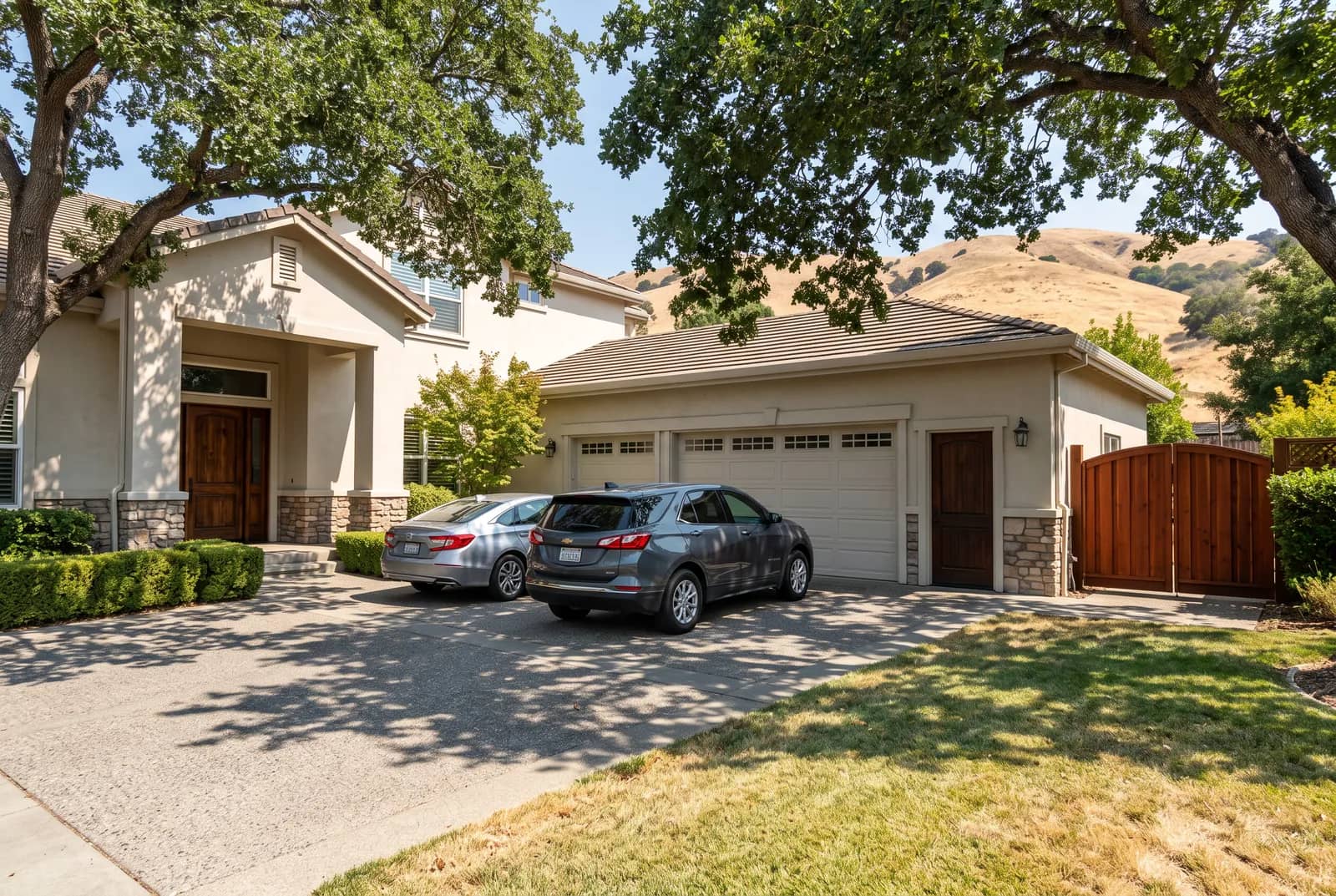
Walk the outside of an ordinary Danville house from the seventies, eighties or nineties and you will find five ways through the envelope. The front entry. The service door on the side of the garage, usually onto a narrow side yard. A sliding glass door from the family room onto the patio. A pair of French doors, often from a dining room or a primary bedroom. And the gate through the fence into the back yard, which is a door in every sense that matters even though nobody calls it one.
Five openings, and the calls are not spread evenly across them. The front entry produces the large majority, and frequency of use is not the reason. Plenty of households open the patio slider more often than the entry all summer long and never once ring about it.
It produces the calls because it is the biggest, heaviest, most exposed piece of moving timber on the property, and because everything this valley does to wood, it does to that leaf first.
Why the entry is the one that moves
It is wide and it is solid. Entry doors of this era are frequently three feet across and an inch and three-quarters thick, and the leaf may carry glass in it or a sidelight beside it, which puts more joints and more materials into one panel. There is more wood there to swell and shrink than in any other door on the house, and swelling shows up across the width, which is exactly where the bolt has to reach.
It faces the weather on one side and a conditioned room on the other. A summer afternoon in the San Ramon Valley is hot and dry and in a heat wave it goes past a hundred, while the hallway behind that leaf stays wherever the thermostat put it. That difference across an inch and three-quarters of wood is what makes a front door behave differently from an interior one.
And it is heavy, so it works its hinges. Three hinges carrying that weight through a few thousand cycles a year, on screws that in most builds only reach the jamb board, produce a slow permanent settle toward the latch side on top of the seasonal movement. Between the two, the bolt stops arriving where the hole is, the household starts lifting the handle without discussing it, and eventually somebody calls to report that the lock has broken.
What the other four actually need
The garage service door is narrower and lighter, so it moves less, but it usually has the cheapest hardware on the property and it often faces west down a hot side yard. What it needs is rarely alignment. It is a cylinder that has been baking in the sun since the house was built and a strike screwed into trim. It is also, on most houses, the one exterior door that nobody has locked deliberately in years.
The slider is a different machine entirely. It does not swell across a stile because it is glass in a frame, and it does not sag on hinges because it does not have any. What goes wrong is the rollers wearing so the panel drops in its track, and the small keeper the latch hooks into moving out of reach. The thumb latch on the handle is not what is holding that door, whatever it feels like. What holds it is that keeper and, if you have one, a bar or pin in the track.
French doors produce the most misdiagnosed call on the list. There is an active leaf with the handle and an inactive leaf held by flush bolts at the top and bottom, usually behind a strip called an astragal. When the pair goes out of alignment, the flush bolts no longer drop cleanly into their sockets in the header and the threshold, so the inactive leaf floats a fraction and the deadbolt on the active leaf has nothing solid to shut against. Households report this as a broken handle. It is almost never the handle.
The gate to the back yard needs the least and gets the least. A latch, sometimes a cylinder, a self-closing spring and hinges that a wooden gate in this climate pulls out of square within a few seasons. Worth pinning to the house key while a technician is already on site, at $31 to $49, so the ring stops growing.
The door that produces the lockout is not the one that produces the repair
Two different lists, worth separating. The repair calls cluster on the entry, for the reasons above. The lockouts cluster somewhere else entirely, and the pattern is consistent: somebody steps out into the side yard or the back yard for two minutes, a self-closing gate or a spring-latched service door swings shut behind them, and every key in the house is on the other side of it.
That is a house lockout at $145 to $265, opened without damage wherever the mechanism allows, with the $89 service call inside the figure and $55 or $95 riding on the hour if it is late. The repeat is prevented for very little: the gate latch or the service door cylinder pinned to the same key as the house, so that a spare you already carry opens it, and a key that lives somewhere other than the ring in your pocket.
The other frequent version is a household that has been getting in and out for a decade through one door and has never confirmed that any of the other four still works with the keys they hold. That is worth ten minutes on a Saturday, with each door locked and unlocked from both sides using the key you actually carry, and it is free.
Doing all five in one stop
The economics point strongly at one visit. One $89 service call covers the stop however many doors are on the list, and rekeying runs $31 to $49 a cylinder with everything after the first sitting low in that band, since the combination has already been chosen and the key has already been cut to it. Five doors handled together cost a small fraction of five doors handled on five different afternoons.
So when you ring, describe the property rather than the emergency. Front entry with a handleset and a deadbolt. Garage service door. Slider with a keeper that has stopped catching. French doors where the second leaf floats. Side gate. That description turns into a single figure before the van moves, and it means the right parts are on board rather than being fetched halfway through.
Arrival runs about 19 minutes on average, roughly 12 in Downtown Danville, 14 on the Westside, 16 in Greenbrook, 17 at Danville Station, 19 in Sycamore Valley, 21 at Magee Ranch, 23 to Crow Canyon Country Club and 26 to Blackhawk. Where a gate and a check-in stand between the street and the driveway, that time is quoted on top rather than folded in to make the number look better.
The short version
The entry moves because it is big, heavy and exposed, so it is the door that stops locking and it is the door that gets the alignment work. The service door and the gate produce the lockouts, so they are the doors that want a key you already carry. The slider needs its rollers and its keeper looked at rather than its handle. The French doors need their flush bolts to reach, and everything else follows from that.
And all five belong on one key. Not because it is tidy, though it is, but because a spare key is only a useful object if it opens more than one of the five doors on the house.
Quick answers
Why does only my front door give trouble when the others never do?+
It is the widest, heaviest and most exposed leaf on the house, with weather on one face and a conditioned room on the other. It swells and shrinks more than any other door and it settles on its hinges under its own weight. The other four are lighter, more sheltered, or not hung on hinges at all.
My French doors will not lock properly. Is the handle broken?+
Rarely. The inactive leaf is held by flush bolts at the top and bottom, and when the pair goes out of square those bolts stop reaching their sockets, so the deadbolt on the active leaf has nothing solid to close against. The correction is at the bolts and their sockets, not at the handle.
Can all five doors go on one key in a single visit?+
Usually yes. Rekeying runs $31 to $49 a cylinder, everything after the first sits low in that band, and the $89 visit is charged for the stop rather than for each lock. Where a slider or a gate takes a different key blank, one cylinder gets swapped so it can join the set, and that is said before it is done.
Need it handled rather than read about?
(925) 431-6470